

Construction sites across the United States lose over $1 billion annually to theft and vandalism, proving that traditional security methods are often failing to protect high-value assets. If you’re managing a remote or unpowered site in California, you’ve likely realized that hiring a team of physical guards is becoming a massive financial burden that doesn’t always guarantee results. It’s frustrating to pay for a service that still leaves your equipment vulnerable to after-hours crime. Understanding the total mobile surveillance trailer cost is the first step toward a more efficient, tech-forward strategy.
This guide will help you navigate the complexities of mobile security by evaluating hardware specs, connectivity requirements, and the long-term ROI of remote monitoring. We’ll provide a transparent look at the total cost of ownership, helping you move past the confusion of hardware versus monitoring fees. You will learn how to choose a security solution that pays for itself through crime prevention and provides reliable, 24/7 protection. We will also examine how virtual guarding and voice-down intervention create a more effective perimeter than traditional patrols alone, ensuring your investment remains both a superior safety measure and a savvy business decision.
Key Takeaways
- Evaluate how advanced camera technology, such as 4K resolution and thermal imaging, impacts both your initial investment and the effectiveness of your security perimeter.
- Determine whether renting, leasing, or purchasing is the most financially intelligent choice based on your project duration and cash flow requirements.
- Calculate the total mobile surveillance trailer cost by accounting for critical operational expenses like high-bandwidth cellular data and professional remote video monitoring.
- Identify industry-specific cost drivers for California sites, including the specialized deployment needs of Los Angeles construction yards and logistics hubs.
- Discover how to maximize your security budget by integrating mobile units with existing access control systems and fixed camera networks for a comprehensive defense strategy.
Key Factors Influencing Mobile Surveillance Trailer Cost in 2026
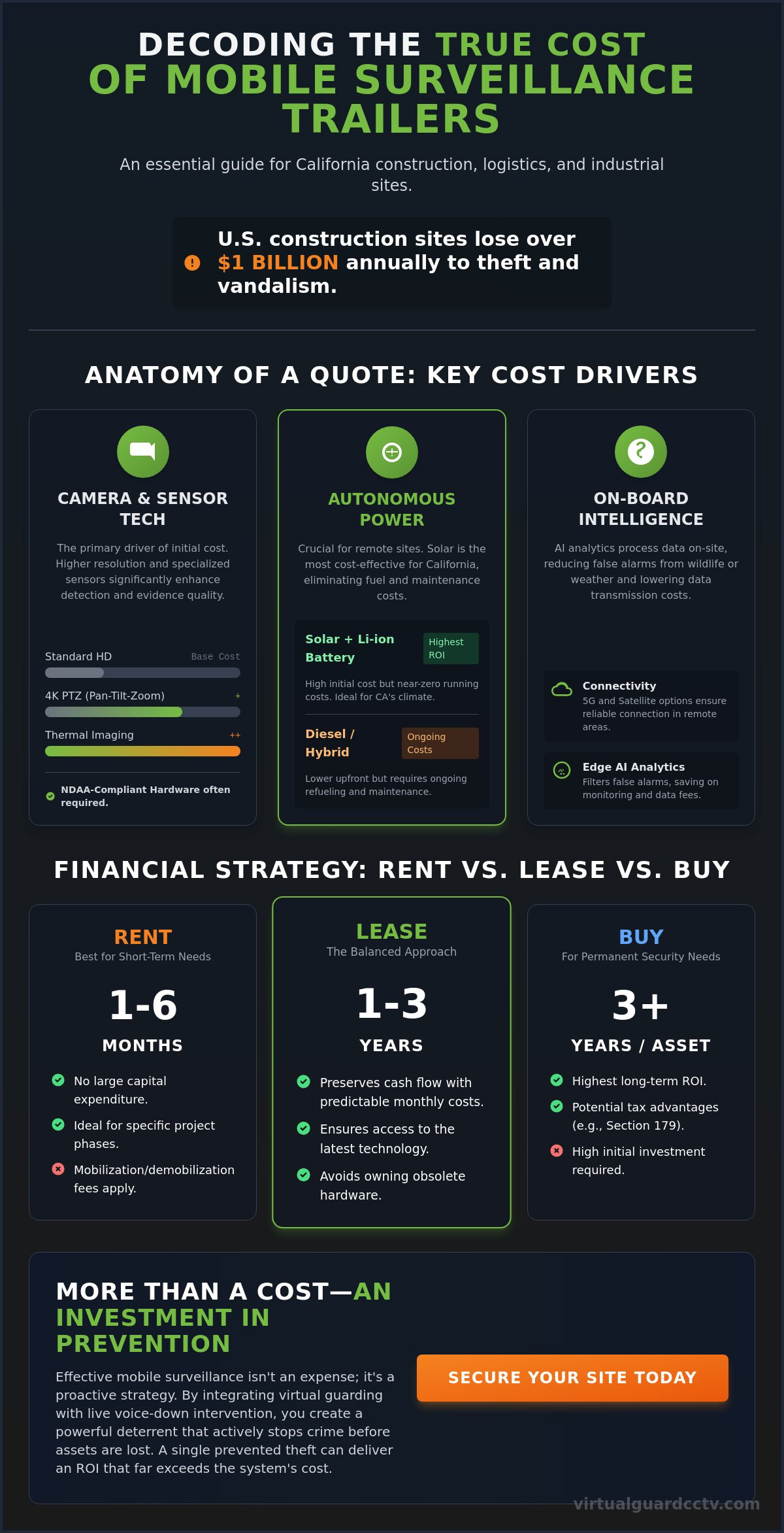
Calculating the total mobile surveillance trailer cost requires looking beyond the physical unit to the technology driving its performance. In the current security market, the price point of a mobile unit is rarely determined by the trailer’s size alone. Instead, the sophistication of the internal components and their ability to operate autonomously in remote California environments dictate the investment level. A unit equipped with 5G integration and satellite backup options ensures connectivity in rural or high-interference areas, though these advanced communication tools represent a higher tier of equipment compared to standard cellular setups.
On-board AI and edge analytics represent a significant shift in cost efficiency. By processing video data directly on the trailer, these systems filter out false alarms caused by animals or weather, only alerting monitoring agents when a genuine threat is detected. This intelligence reduces the bandwidth required for streaming, which can lower long-term cellular data expenses. Additionally, structural features like mast height and stabilization systems affect the price. Higher masts provide a wider field of view and act as a visual deterrent, but they require robust stabilization to remain effective during the high-wind conditions often found on California construction sites.
Hardware Specifications and Camera Quality
The selection of camera hardware is a primary driver of the initial expense. There’s a clear price jump between standard fixed cameras and multi-sensor PTZ (Pan-Tilt-Zoom) units that offer 360-degree coverage. For commercial sites with high-value inventory, 4K resolution is often the baseline for usable evidence. Many high-security commercial contracts now mandate NDAA-compliant hardware, which ensures the equipment meets federal security standards. While thermal imaging adds to the upfront cost, it remains essential for large perimeters where traditional lighting is unavailable, allowing for detection in total darkness.
Power Systems: Solar, Diesel, and Hybrid Options
Power autonomy is the backbone of any remote security strategy. High-efficiency solar panels paired with large battery banks allow trailers to operate indefinitely without external power or frequent refueling. While lithium-ion batteries require a larger initial investment than lead-acid alternatives, they offer more charge cycles and better performance in extreme temperatures, reducing the total cost of ownership over the unit’s lifespan. Because of the consistent sunlight, solar powered surveillance trailers are particularly cost-effective for California businesses, as they eliminate the ongoing fuel and maintenance costs associated with diesel generators.
The Financial Debate: Buying vs. Leasing vs. Renting
Deciding on the right acquisition model is as critical as the hardware itself. For many California commercial sites, the decision hinges on the project’s lifespan and available capital. Short-term rentals are ideal for construction phases or seasonal retail events where protection is only required for a few months. This model provides immediate security without a large upfront capital expenditure. However, you must account for mobilization and demobilization fees. These charges cover the logistics of delivery, positioning, and technical setup, which can impact the short-term mobile surveillance trailer cost if the unit is moved frequently.
Leasing offers a pragmatic middle ground for businesses that want to preserve monthly cash flow. This approach allows you to upgrade your technology every two or three years, ensuring your site is always protected by the latest AI and 4K camera systems. Because security technology evolves rapidly, leasing prevents your company from being stuck with obsolete hardware. For permanent industrial facilities or trucking yards, an outright purchase often provides the highest long-term ROI. While the initial investment is higher, the unit eventually becomes a low-cost asset that only requires minimal fees for monitoring and data.
Business owners should also consider potential tax advantages. In the United States, Section 179 deductions may allow companies to deduct the full purchase price of qualifying security equipment in the year it’s placed into service. This can significantly offset the initial cost, making ownership a savvy financial decision. If you’re analyzing how these units fit into your broader protection strategy, a professional security system design can help determine the most efficient deployment for your specific site.
Short-Term Rental Pricing Dynamics
Most providers in the Los Angeles security market require a minimum contract length, typically ranging from 30 to 90 days. If your project is expected to last longer than 18 months, the cumulative rental fees often surpass the cost of a 12-month lease or a direct purchase. It’s vital to calculate the total cost of ownership over the entire project duration rather than focusing solely on the monthly rate. This ensures you don’t overpay for flexibility you might not actually need.
Long-Term ROI of Ownership
The “payback period” for a mobile unit is remarkably short when compared to traditional methods. According to industry data, an unarmed 24/7 security guard can cost between $16,500 and $20,400 per month. In contrast, a mobile trailer with remote monitoring costs a fraction of that amount, often paying for itself in less than two years. While ownership means you’re responsible for maintenance and firmware updates, well-maintained units retain strong resale value in the secondary market, further improving your total return.
Operational Costs: Monitoring, Connectivity, and Maintenance
Hardware acquisition is merely the first phase of your security investment. To ensure the unit functions as a reliable deterrent, you must account for the ongoing operational expenses that keep the technology active and responsive. These recurring fees often represent a significant portion of the total mobile surveillance trailer cost, especially when you prioritize high-resolution streaming and immediate human intervention. Neglecting these factors can lead to unexpected budget spikes or, worse, a system that fails when you need it most.
High-resolution 4K video provides the clarity needed for evidence, but it places heavy demands on cellular networks. While basic data plans might suffice for low-frame-rate recording, real-time response requires robust 5G connectivity. Depending on the activity level at your site, cellular data plans typically range from $100 to $300 per month. Some remote California sites might even opt for satellite options like Starlink to ensure uninterrupted uptime in areas where cellular towers are sparse. This ensures your video feed remains fluid and accessible from any location.
Storage strategy also influences your monthly budget. Edge recording saves data directly to the trailer’s internal drives, which reduces monthly subscription fees but can make remote retrieval slower. Cloud storage offers faster access and redundant backups; however, it usually requires a monthly per-camera fee. Balancing these two options depends on how quickly your team needs to review footage after an incident. Most commercial buyers find that a hybrid approach offers the best mix of speed and cost-efficiency.
Live Remote Monitoring vs. Passive Recording
The most significant variable in your monthly budget is the level of human oversight. Passive “record-only” systems are the least expensive, yet they only provide evidence after a crime has occurred. In contrast, virtual guarding services southern california utilize AI-filtered alerts to trigger live human intervention. When an agent uses voice-down features to speak directly to a trespasser, the likelihood of a successful deterrent increases dramatically. This proactive labor naturally involves higher service fees than automated alerts, but it eliminates the need for expensive on-site personnel.
Connectivity and Software Licensing
Software maintenance is a non-negotiable aspect of modern security. Video Management System (VMS) licensing often carries annual renewal fees that cover technical support and feature updates. Regular cybersecurity firmware updates are equally vital. These updates protect your hardware from vulnerabilities, ensuring that your surveillance network remains a secure asset rather than a liability. Routine physical maintenance, such as cleaning solar panels in dusty California environments and checking battery health, ensures the system remains operational 24/7 without costly emergency repairs.
Industry-Specific Cost Drivers for Los Angeles Businesses
The specific environmental and criminal challenges in Southern California directly influence the mobile surveillance trailer cost for local businesses. In Los Angeles, where property crime rates often fluctuate based on neighborhood and industry, a generic security setup rarely suffices. For instance, the frequent targeting of catalytic converters across trucking yards and industrial hubs has forced managers to prioritize trailers equipped with specific low-angle detection sensors. These specialized needs mean that the baseline price often shifts based on the level of intervention required to secure high-value assets in high-risk zones.
Retailers and parking lot managers also utilize these trailers to mitigate liability and manage risk. High-resolution footage is vital for investigating “slip and fall” claims and addressing parking lot altercations that can lead to expensive lawsuits. For temporary needs like stadium events or seasonal retail surges, high-capacity units with multi-sensor arrays provide the crowd control necessary to maintain safety. These temporary deployments require rapid mobilization, which is a key factor in the overall cost calculation for short-term projects.
Securing Construction and Industrial Sites
Construction projects in California are dynamic; they move through various phases that require different levels of oversight. Mobile units are particularly effective for commercial security system installation in Los Angeles because they can be relocated as the project perimeter shifts. Ruggedized trailers are a necessity in these environments. Dust, unpaved terrain, and heavy machinery vibration require reinforced chassis and sealed camera housings. While these features increase the initial investment, they prevent the frequent equipment failures that plague cheaper, consumer-grade alternatives. The high visibility of a 20-foot mast acts as a powerful deterrent, often stopping theft before it starts and saving companies from the $1 billion in annual losses reported across the U.S. construction industry.
Los Angeles Logistics and High-Value Asset Protection
Logistics facilities and shipping yards face unique threats under the cover of darkness. Large, unlit yards are difficult to patrol with physical guards alone, making thermal imaging a non-negotiable requirement for many operators. Thermal cameras detect the heat signatures of intruders long before they reach a vehicle or warehouse door, providing a level of visibility that standard cameras cannot match in low-light conditions. When paired with voice-down intervention, a remote agent can warn a trespasser that they are being recorded and that local authorities have been notified. This immediate response is often the difference between a minor incident and a devastating loss of inventory. To find a solution tailored to your specific industry risks, contact the experts at Guardian Integrated Security to discuss your deployment options.
Maximizing Security Budget with Guardian Integrated Security
Guardian Integrated Security shifts the focus from simple equipment procurement to a comprehensive protection strategy. Instead of offering one-size-fits-all hardware, we provide custom-engineered units tailored to specific site vulnerabilities. This approach ensures that the mobile surveillance trailer cost aligns perfectly with your operational needs, preventing you from paying for unnecessary features while ensuring critical gaps are covered. By integrating these mobile units with your existing access control and fixed camera networks, we create a unified defense system that is far more powerful than isolated components.
Local Los Angeles support is a cornerstone of our service model. Working with a regional partner means you benefit from faster deployment times and immediate technical troubleshooting. If a unit requires maintenance or a camera needs calibration, our proximity ensures your site isn’t left vulnerable for days. This local reliability, combined with our technical sophistication, positions our service as both a superior safety measure and a financially intelligent investment for California business owners. It’s a proactive energy that defines our persona as both an elite security specialist and a protective local ally.
The Synergy of Hardware and Virtual Guarding
Implementing virtual guarding makes a mobile trailer 60% more effective than passive recording by transforming a silent observer into an active participant. Our off-site professionals provide real-time threat detection, utilizing AI-filtered alerts to focus on genuine security breaches rather than false alarms. The financial impact is substantial. While industry data shows that an unarmed 24/7 security guard can cost between $16,500 and $20,400 per month, a monitored trailer unit typically costs a fraction of that amount while providing superior coverage. This allows you to reallocate your security budget toward technology that never sleeps and never leaves its post.
Local Expertise and Rapid Deployment in Southern California
Choosing an LA-based security partner allows for more accurate site assessments that account for local crime trends and environmental factors. We understand the nuances of the Southern California commercial landscape, from the busy ports to expanding construction zones. To further strengthen your perimeter, we offer vehicle patrol services that can complement your mobile units during high-risk hours. This multi-layered approach provides the constant vigilance required to protect high-value assets and ensure peace of mind. Get a custom quote for your Los Angeles mobile surveillance needs today and secure your site with a partner that understands your business.
Investing in Smarter Site Protection
Selecting the right security solution requires a careful balance of advanced hardware and strategic operational planning. You’ve seen how factors like 4K resolution, AI-powered analytics, and power autonomy influence the total mobile surveillance trailer cost. By choosing a model that integrates with professional remote video monitoring, you replace expensive physical guards with a system that provides constant, proactive vigilance. This transition doesn’t just save money; it improves the overall safety of your high-value assets through superior technology and constant observation.
Guardian Integrated Security brings over 20 years of specialized experience to the Los Angeles commercial market. We provide custom-engineered trailers specifically designed for high-stakes industrial applications, ensuring your hardware survives the most demanding environments. Our proprietary voice-down intervention technology allows our agents to speak directly to trespassers, providing an immediate response that traditional recording systems simply cannot match. Our team understands the specific local threats facing your California site and provides the technical sophistication needed to neutralize them before a loss occurs. Take the next step toward a more secure and cost-efficient future by speaking with our experts. We look forward to helping you build a safer, more resilient business environment.
Request a Personalized Mobile Surveillance Cost Analysis
Frequently Asked Questions
How much does it typically cost to rent a mobile surveillance trailer per month?
Monthly rental rates are determined by the complexity of the integrated technology and the length of the service agreement. In the California market, prices vary based on whether the unit utilizes basic recording or advanced AI-powered detection. Long-term contracts generally offer lower monthly rates, while short-term deployments for specific events often include mobilization fees to cover the logistics of delivery and setup.
Is it cheaper to buy or lease a mobile security trailer for a 6-month project?
For a six-month duration, renting or leasing is almost always the more financially intelligent choice. Purchasing a unit requires a large upfront capital expenditure and leaves you responsible for long-term storage and depreciation. Renting allows you to access elite technology for the exact window you need it, ensuring you don’t pay for an asset that sits idle once the project concludes.
What are the hidden costs associated with mobile surveillance trailers?
Commonly overlooked expenses include mobilization fees, high-bandwidth cellular data plans, and recurring software licensing. High-resolution 4K streaming requires robust data packages that can increase your monthly commitment. If you choose to own your equipment, you must also budget for cybersecurity firmware updates and regular technical maintenance to ensure the system remains a reliable deterrent against sophisticated threats.
Do solar-powered trailers cost more than diesel-powered units?
Solar-powered trailers typically have a higher initial price point because of the investment in high-efficiency panels and lithium battery banks. However, they eliminate the constant fuel costs and engine maintenance required by diesel generators. In the Southern California climate, solar units are highly cost-effective, providing silent and self-sufficient operation that often results in a lower total cost of ownership over time.
How does remote video monitoring impact the overall cost of a trailer?
Professional monitoring adds a recurring service fee but significantly increases the unit’s ability to prevent crime. This service involves live agents who can immediately respond to AI-filtered alerts, providing a level of protection that passive recording cannot match. While this adds to the total mobile surveillance trailer cost, the investment pays for itself by stopping theft before it leads to expensive asset loss or project delays.
Can a mobile surveillance trailer replace a physical security guard?
A monitored surveillance unit can effectively replace a physical security guard while offering more comprehensive coverage. Unlike a human guard who has limited visibility and requires breaks, a trailer provides 360-degree observation and constant vigilance. When integrated with voice-down intervention, these units offer a proactive response that matches the deterrent power of on-site personnel at a significantly lower monthly rate.
What maintenance is required for a mobile surveillance unit?
Standard maintenance includes cleaning solar panels to maintain power efficiency and checking battery health for reliable off-grid performance. Cameras also require periodic calibration and firmware updates to ensure detection analytics remain accurate. For businesses that rent their units, these maintenance tasks are usually handled by the provider, ensuring the technology stays in peak condition without diverting your internal resources.
Are there specific tax incentives for purchasing security trailers in 2026?
Under Section 179 of the U.S. tax code, businesses may be eligible to deduct the full purchase price of qualifying security equipment in the year it is deployed. This incentive helps offset the initial mobile surveillance trailer cost, making it a savvy financial decision for permanent industrial sites. It is advisable to consult with a tax professional to understand how these specific deductions apply to your commercial security investment.