GET A QUOTE
Industries We Protect

Construction & Industrial Security Monitoring

Where the Losses Happen

Industrial Sites Lose Money in the Hours Nobody Is There

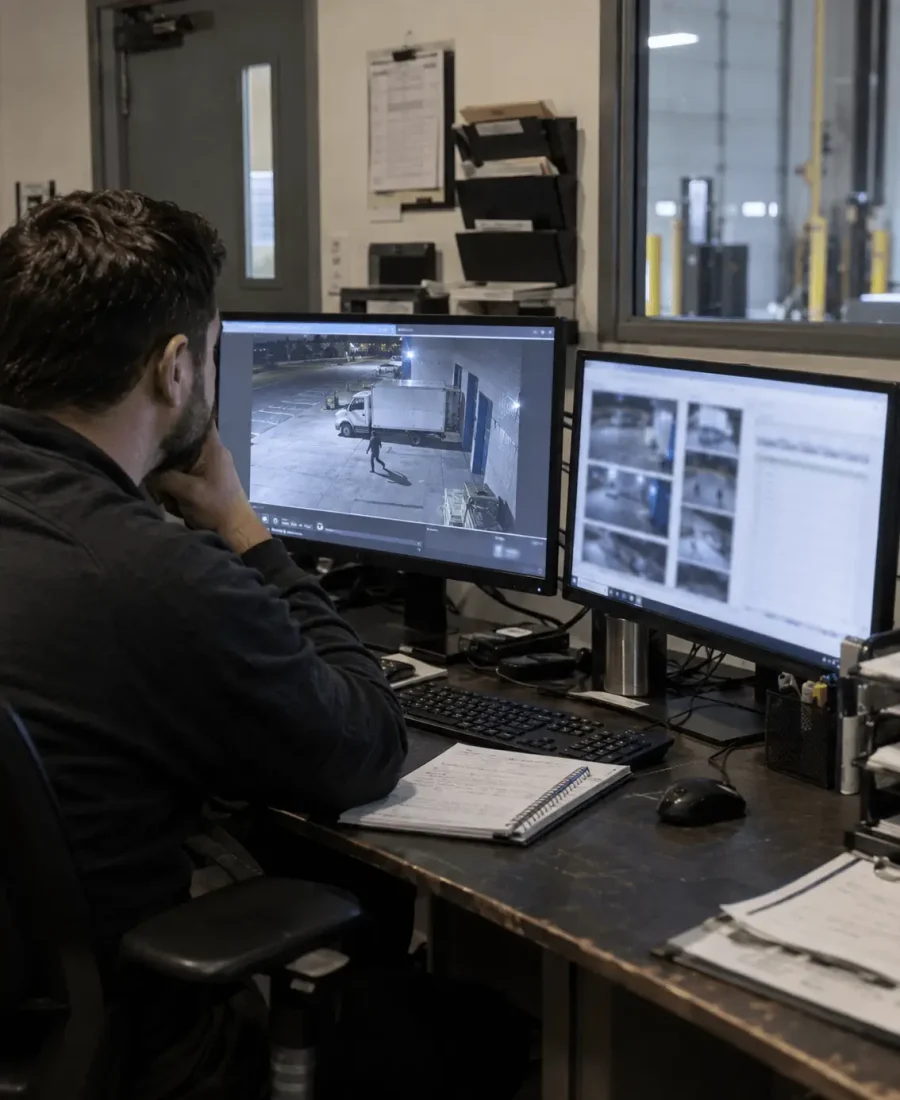
Industrial site security monitoring means trained operators watching your cameras live while the site is empty. When someone crosses a fence line or enters a yard after hours, an operator sees it, speaks to them through on-site speakers, and calls police while the intrusion is still happening.

Construction sites, warehouses, distribution centers and manufacturing plants share the same problem in different shapes. They hold high-value material in the open. They cover more ground than a person can watch. And they sit empty for long stretches, on nights, weekends, and through shutdowns.

Recorded cameras document those hours. They do not interrupt them. The footage is reviewed the next morning, by which point the copper is gone, the trailer has left, or the equipment has been stripped.

The difference is whether anyone is watching while it happens. An operator who sees a person walking between trailers at two in the morning can speak to them before anything is taken. Most people leave the moment a voice describes what they are wearing.

Each of the four property types below faces this differently. Pick the one that matches your site.

What We Provide

COMPLETE SECURITY SOLUTION

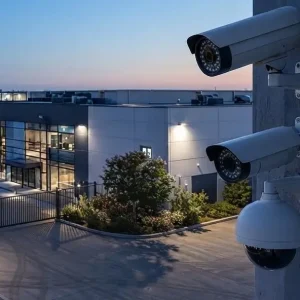
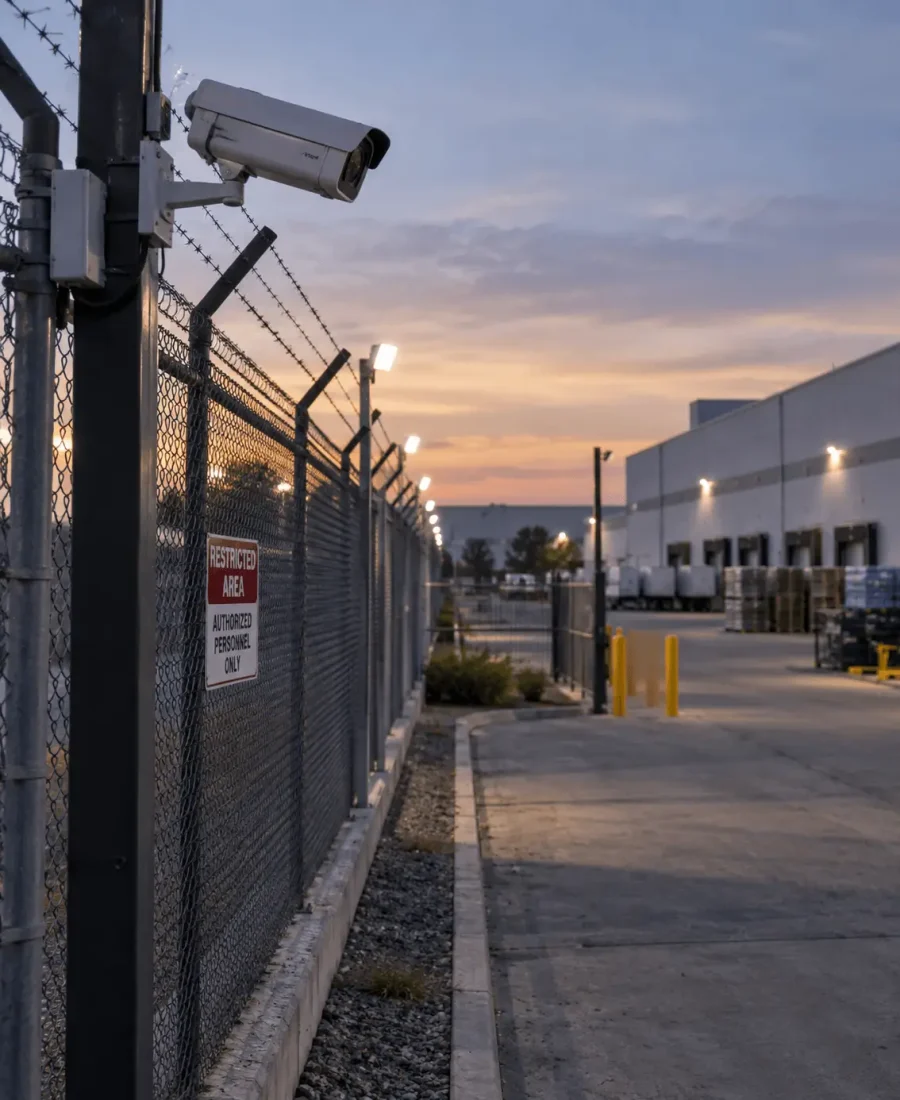
A mounted CCTV camera overlooks a chain-link perimeter fence topped with barbed wire beside a warehouse loading area at sunset
Coverage Geometry

Perimeters Are Long and Access Points Are Many

Industrial properties fail on perimeter, not on buildings, because the fence line is long and the gaps are easy to find on foot.

A warehouse yard, a construction lot and a manufacturing campus all share one trait. The valuable material sits outdoors, and the boundary protecting it is a fence somebody can walk around in the dark.

Camera placement on these sites starts at the boundary and works inward. Gates, fence corners, material stacks and equipment rows get covered first, because that is the order an intruder moves through.

The Empty Hours

Nights, Weekends and Shutdowns

The risk window on an industrial property is defined by the operating schedule, and it is wider than most operators assume.

A construction site is unoccupied from the end of the workday until the first crew arrives. A distribution center may run around the clock but still leaves whole zones unattended between shifts. A plant shutdown can leave a full campus quiet for a week.

Monitoring schedules are built around those windows rather than a fixed template. Coverage follows when the site is actually exposed, not a standard overnight block.

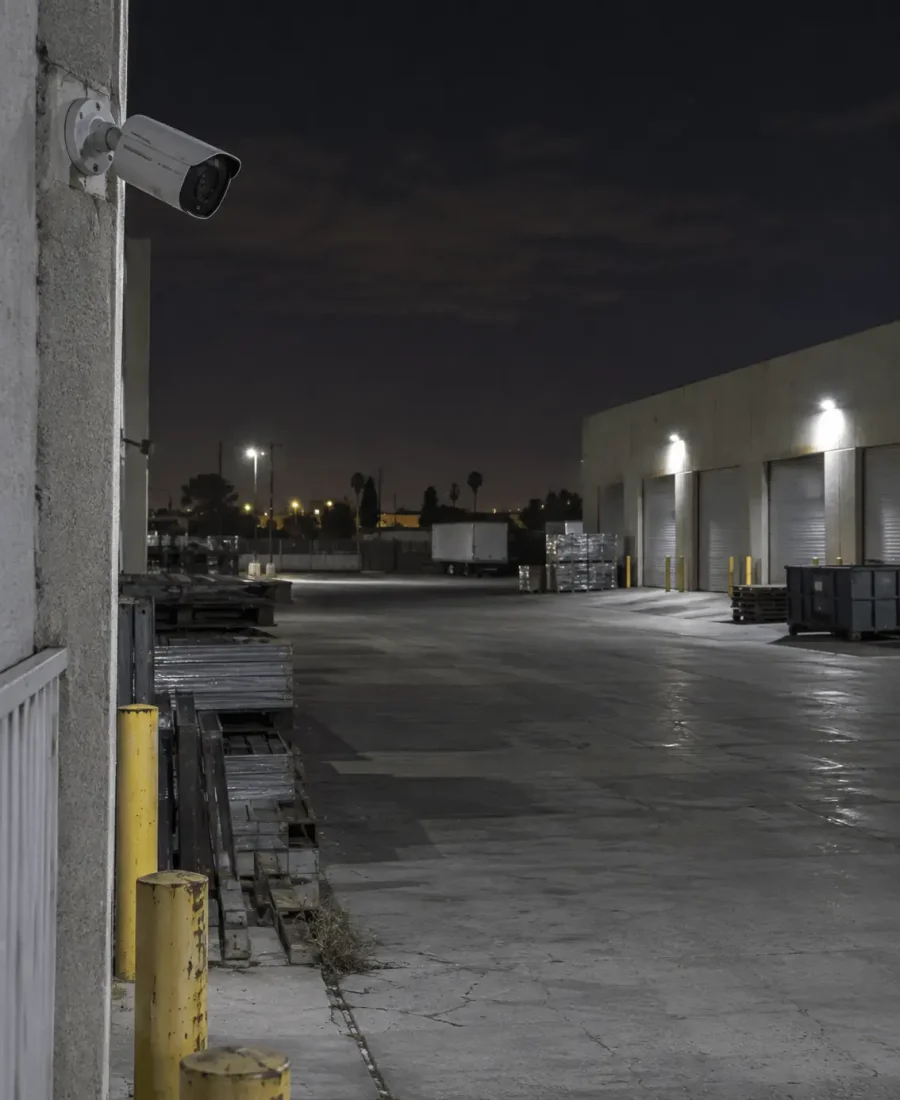
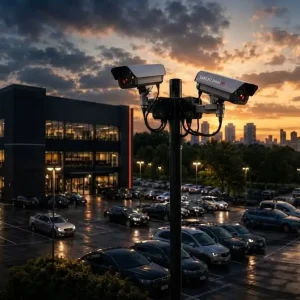
A security camera mounted on a warehouse wall overlooks a loading yard at night, with illuminated loading bays, pallets, stacked materials, and a truck in the distance.
Industries We Protect

Browse Every Sector We Cover

Years of experience
0 +
Businesses Protected
0 +
BBB
A+
Monitoring
0 /7

CONSTRUCTION SERVICES

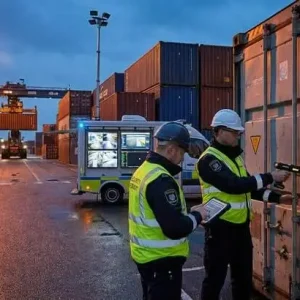
Active job sites lose equipment and materials to unsupervised overnight hours — the exact gap live monitoring is built to close.

Years of experience
0 +
Businesses Protected
0 +
BBB
A+
Monitoring
0 /7

RETAIL SERVICES

Temporary or relocatable camera coverage may be available for suitable retail properties, depending on site requirements, equipment availability, and the selected monitoring plan.

Years of experience
0 +
Businesses Protected
0 +
BBB
A+
Monitoring
0 /7

INDUSTRIAL SERVICES

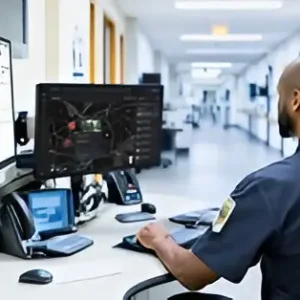
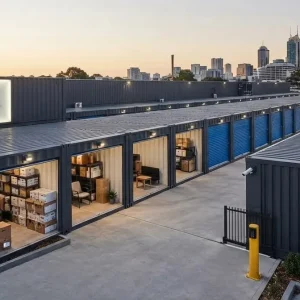
Warehouses and distribution facilities carry high-value inventory across large, hard-to-patrol footprints, where live camera coverage replaces walking a perimeter that’s too big to physically check.
Years of experience
0 +
Businesses Protected
0 +
BBB
A+
Monitoring
0 /7

COMMERCIAL SERVICES

Office buildings, financial institutions, and other commercial properties need monitored coverage of entry points and parking areas outside business hours, when the building sits empty.

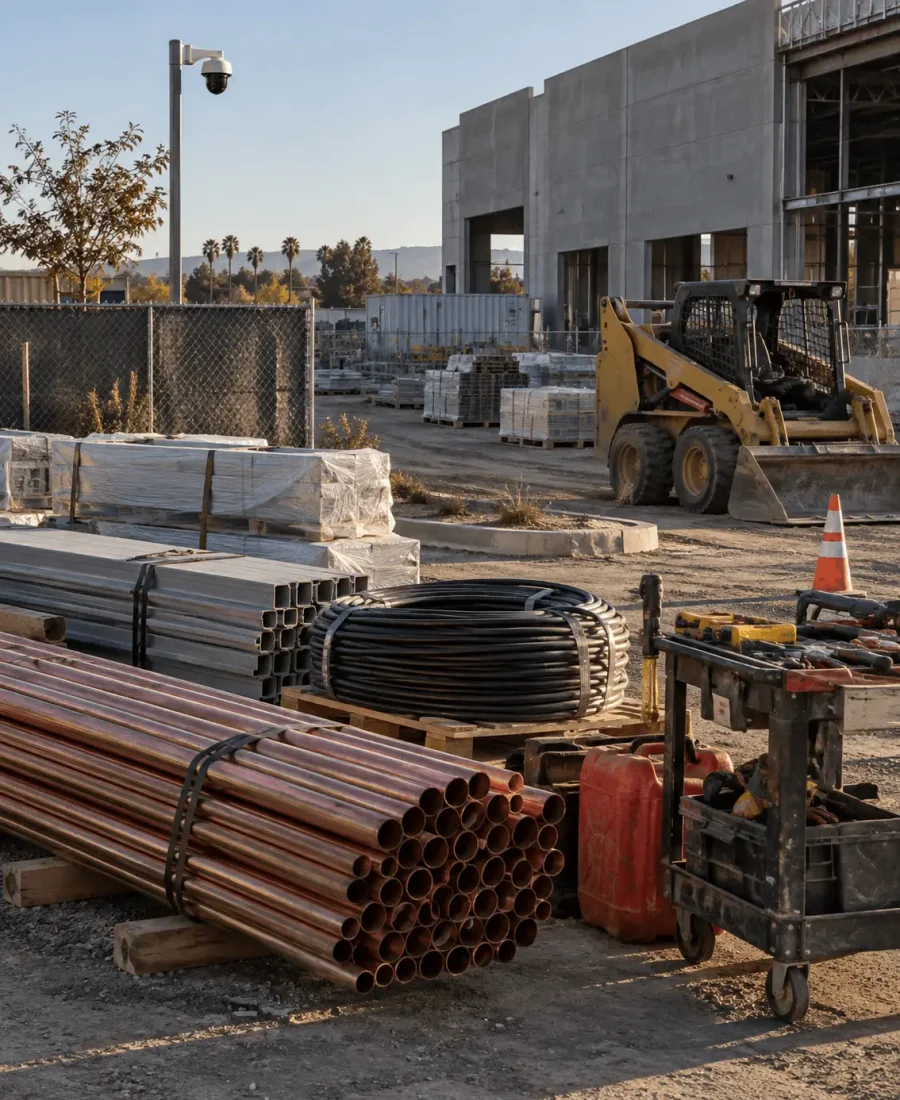
A construction site with bundled metal pipes, stacked building materials, a skid-steer loader, and a wheeled tool cart in the foreground. A surveillance camera is mounted on a pole beside a chain-link fence, with a partially constructed building in the background.
Construction & Industrial

Find Your Industrial Site Type

Every industrial site is exposed in a different way, so the right coverage starts with knowing which type yours is.


Construction sites keep changing as the build moves forward, and power or internet may not be in yet. Warehouses keep stock in fenced yards and loading areas, so coverage centers on the gates and the yard.

Distribution centers have docks and trailers that are busy at some hours and idle at others, so coverage follows the shifts. Manufacturing plants combine a secured building with outdoor material storage, and both need watching.

What Gets Taken

Material, Metal and Machinery

Industrial theft targets what can be moved quickly and sold without provenance, which is why the same categories recur across every site type.

Copper wire and cable, catalytic converters, fuel, hand tools, small plant, and stacked material all move fast. Larger equipment goes less often but costs far more when it does, and it takes a vehicle and time to remove.

That time is the opening. An intrusion that takes twenty minutes to complete can be interrupted in the first two if somebody is watching when it starts.

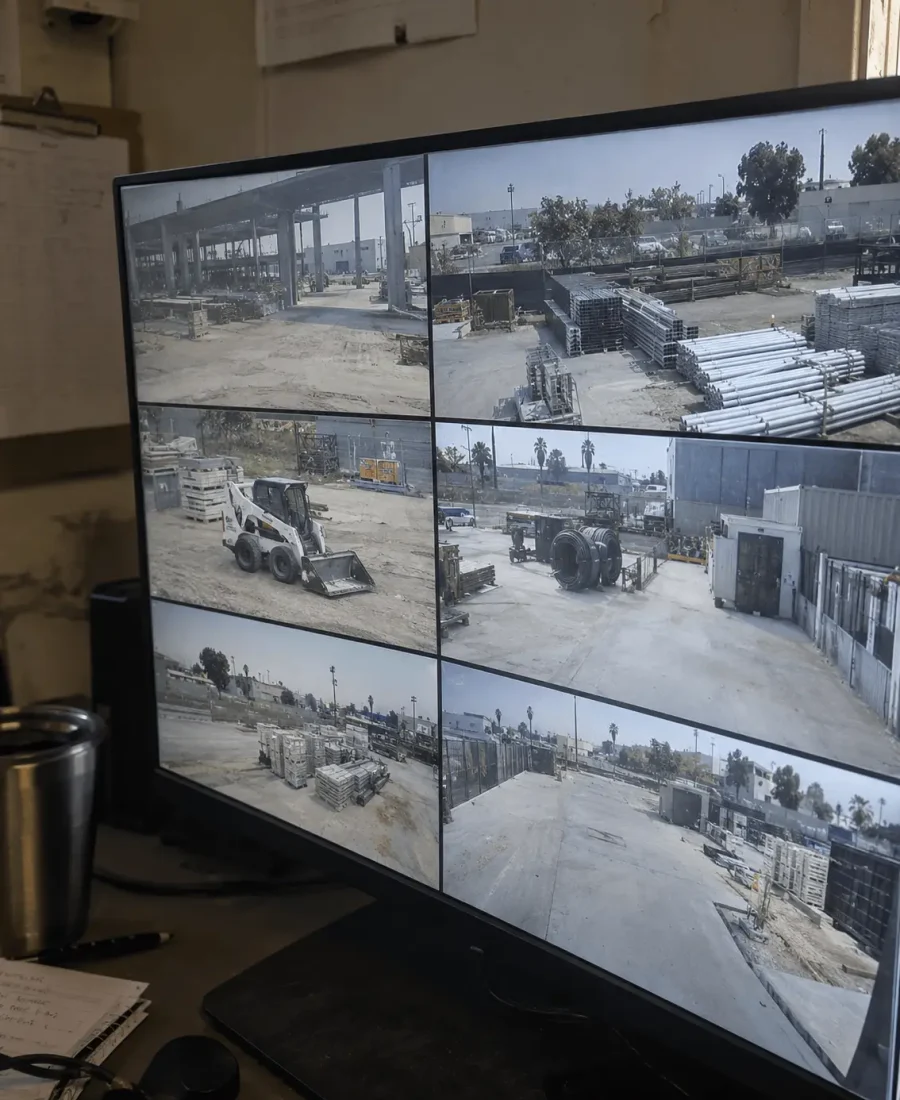
A large desktop monitor displays six surveillance camera views of an industrial yard with stacked metal materials, pallets, equipment, and open work areas. A desk with a keyboard, mouse, metal tumbler, and papers is visible around the monitor.
A seated man in a black top looks at two computer monitors on a desk. The left monitor displays surveillance footage of a person walking near a parked box truck outside a building, while the right monitor shows several smaller camera images and a panel of text. A keyboard, mouse, open notebook, papers, and other desk equipment are visible.
After an Industrial Incident

What You Get After Something Happens

Every event produces a timestamped record you can hand to police, an insurer or a site manager without hunting through footage.

Operators log what they saw, when they saw it, what action they took and how it resolved. The clip is pulled and attached rather than left buried in a week of recording.

For multi-site operators that record also shows which locations generate activity and when, which is usually more useful than any single incident.

Find Out What Your Site Actually Needs

A short call and a look at your layout tells us where the exposure is and what coverage would cost. No obligation.

WHERE WE SERVE

Industrial Coverage Statewide

From Inland Empire logistics corridors to Bay Area fabrication yards, industrial sites across California share the same exposure after hours.

Los Angeles County Orange County San Diego County Riverside County San Bernardino County Ventura County Santa Clara County Alameda County Sacramento County San Joaquin County
faq

Industrial Site Monitoring FAQ

Answers to common questions about video monitoring for construction sites, warehouses, distribution centers, and manufacturing facilities, including camera coverage, monitoring options, and security considerations for industrial properties.

What counts as an industrial property for monitoring?

Construction sites, warehouses, distribution centers, manufacturing plants, fabrication yards and material storage yards all fall into this group. What they share is outdoor storage, a long perimeter and periods when nobody is on site. If your site holds material in the open and empties out at night, the same approach applies.

Yes. Mobile surveillance units run on solar with cellular connectivity and need nothing from the site. They are the usual answer for early-phase construction, remote yards and temporary storage areas where permanent infrastructure does not exist yet.

Either. Existing cameras can often be connected if the coverage is adequate and the image quality holds up at night. Where there are gaps, cameras are added. A site assessment determines which applies before anything is quoted.

The operator issues a live voice warning through on-site speakers, describing the person and telling them they are being recorded. Most intrusions end there. If it continues, the operator calls police and reports it as a crime in progress with a live eyewitness account.

An alarm reports that a sensor triggered. It cannot tell police whether a person is on site or a raccoon crossed a beam, which is why alarm calls are deprioritized. A monitored camera gives an operator eyes on the event, so the call to police describes what is actually happening.