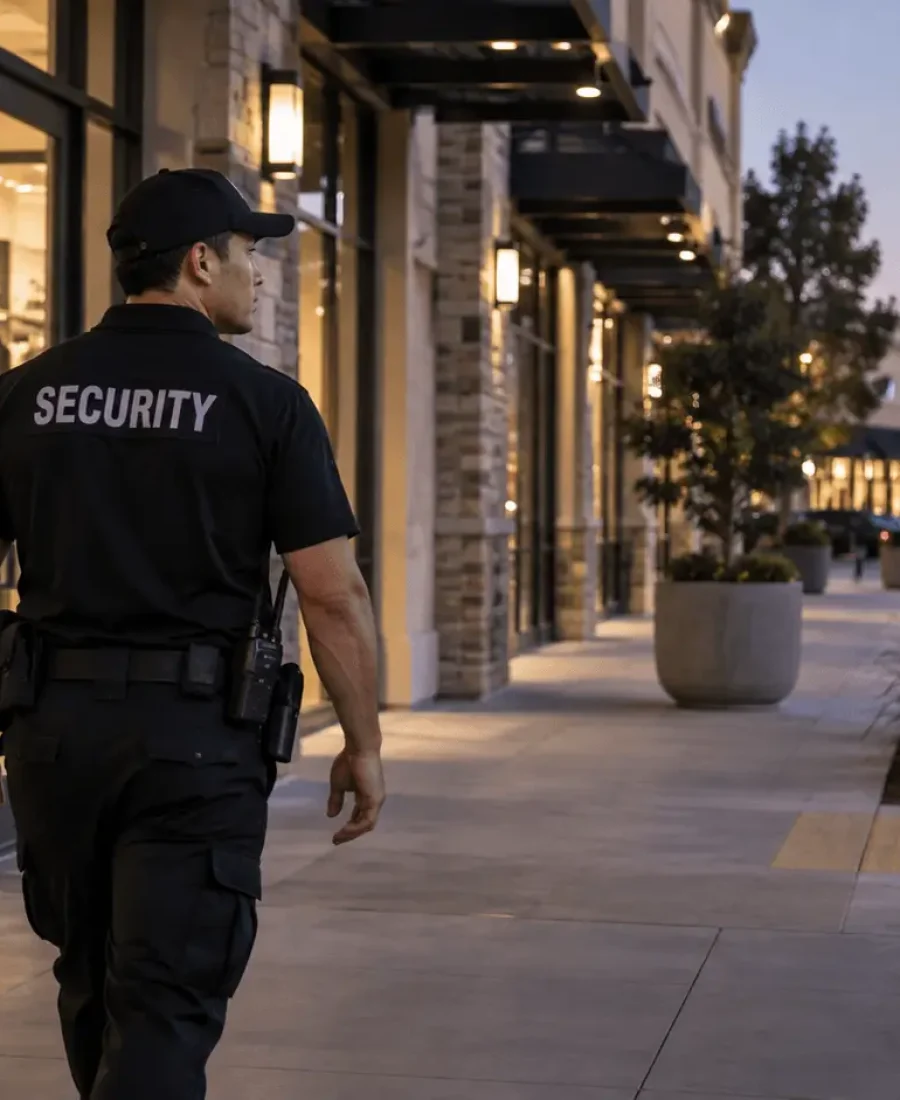
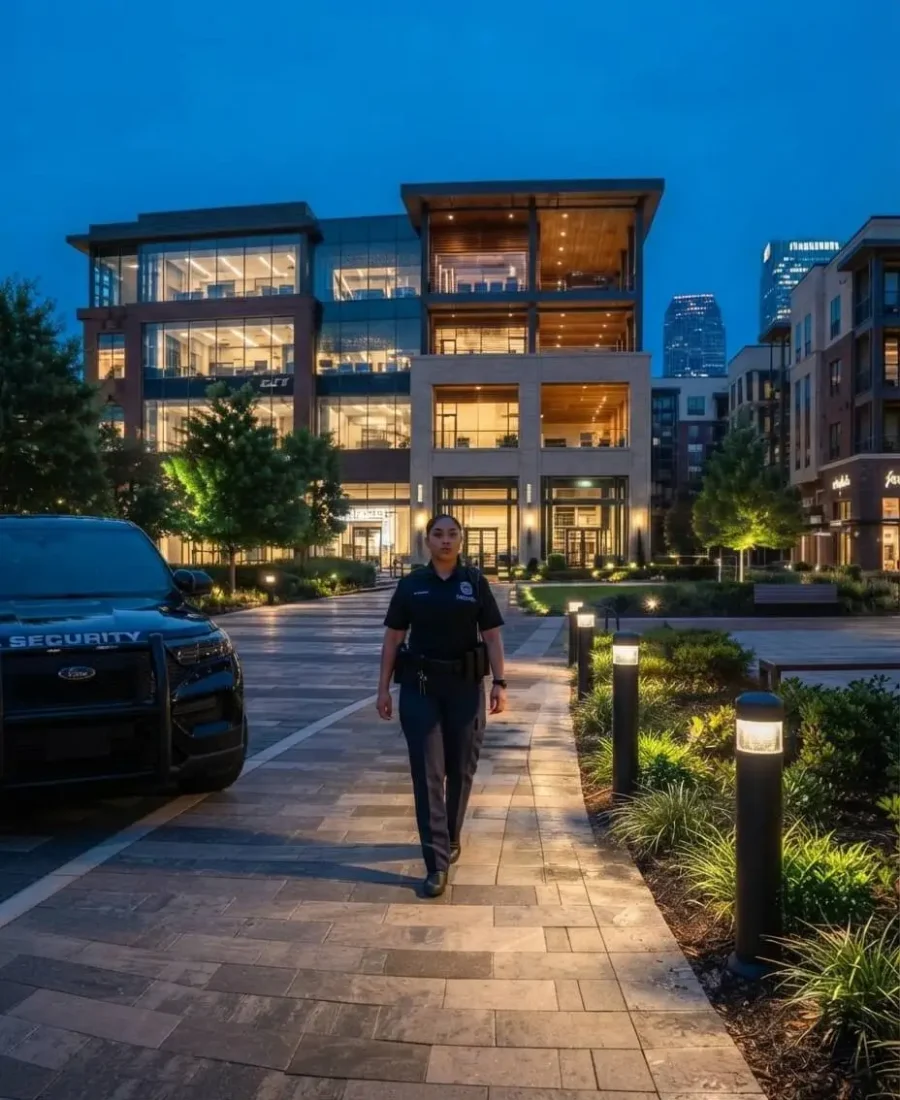
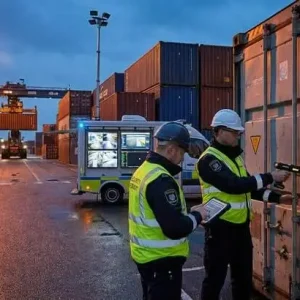
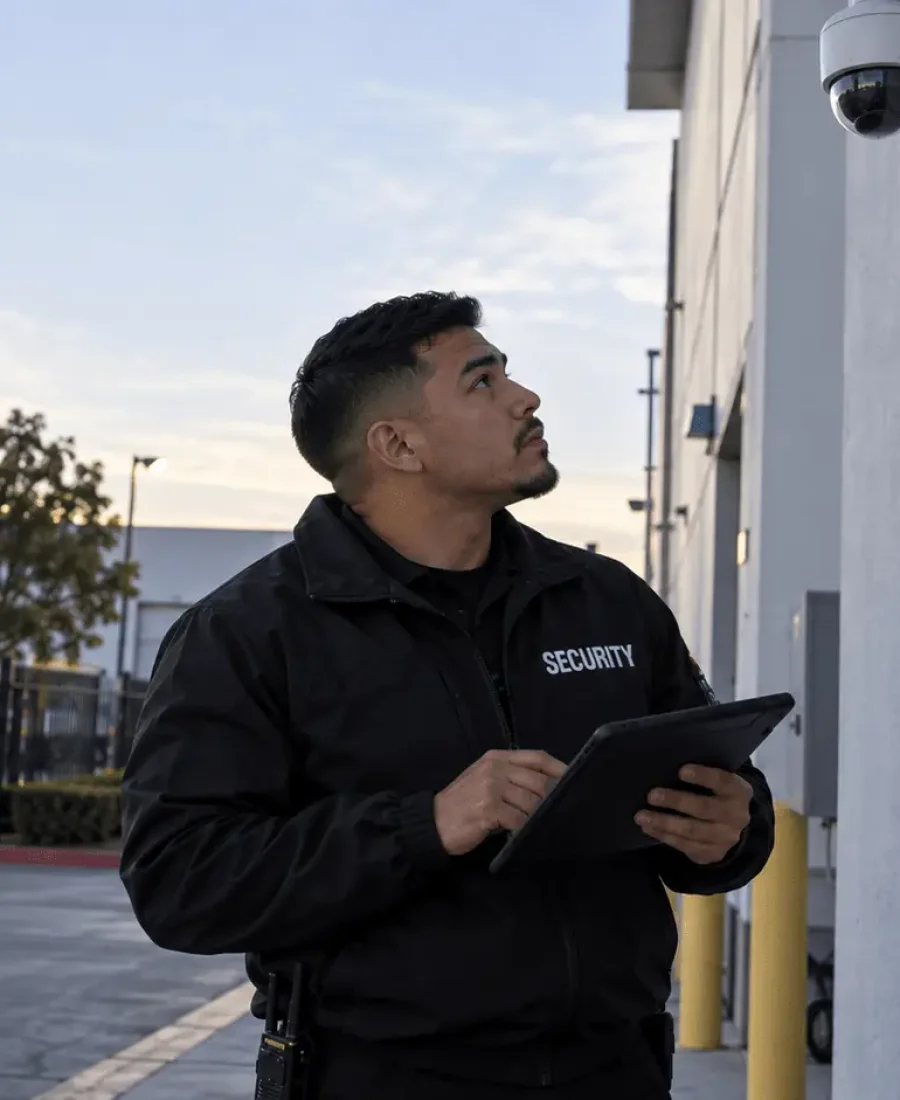
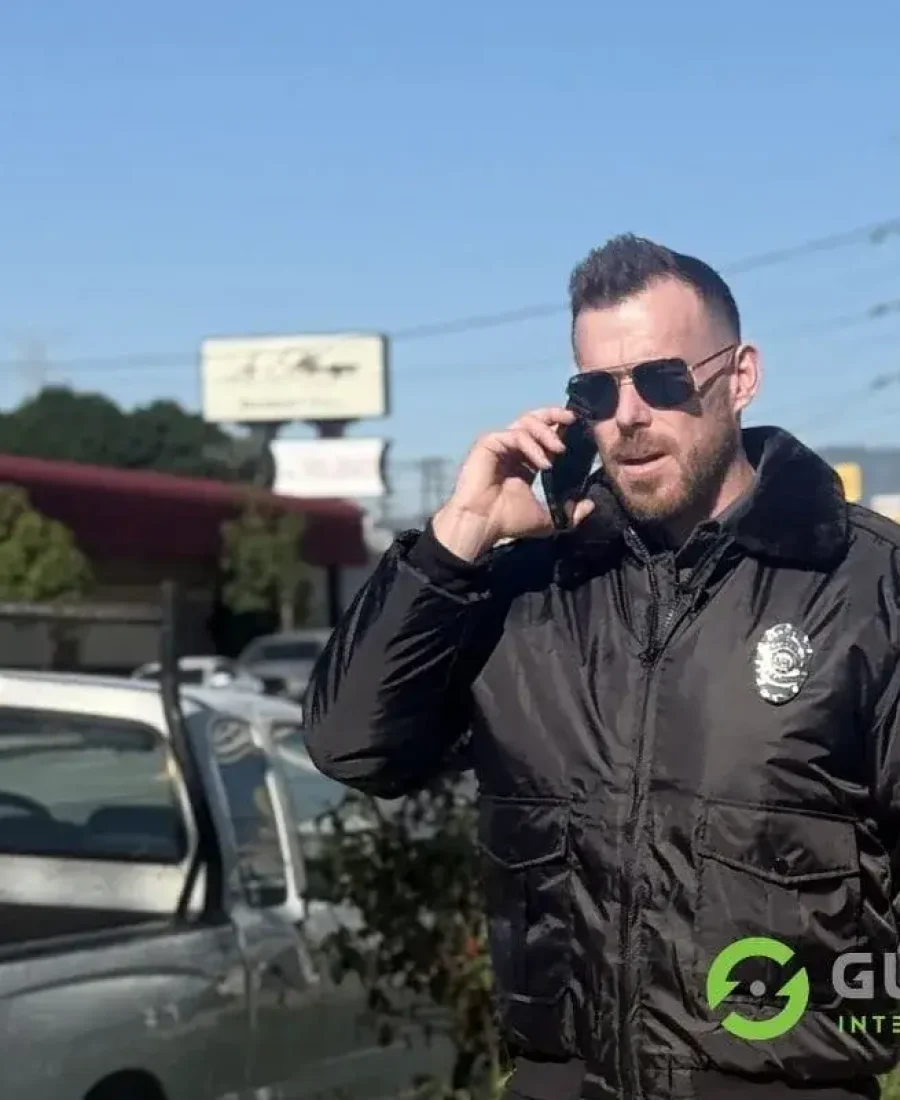
Security guard services place trained, uniformed officers on your property to monitor activity, control access, and respond to incidents in person. For commercial properties, guards patrol grounds, staff entry points, and provide a visible on-site presence that deters intrusion and unauthorized activity around the clock or during scheduled hours.
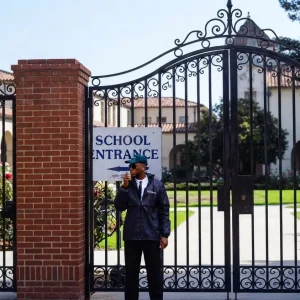
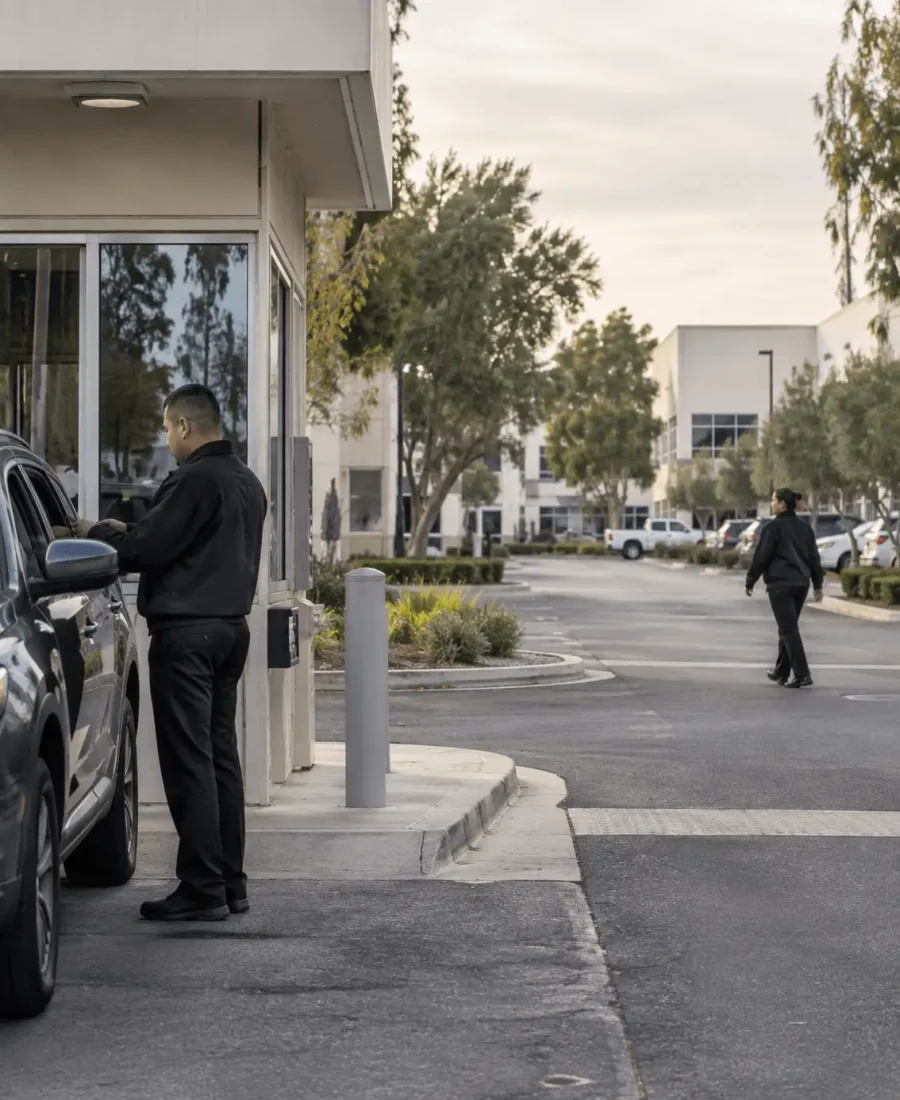
On-site guards fill the gap remote monitoring can’t close by itself — a physical presence to greet visitors, verify credentials at an entry point, and step toward a situation directly when it calls for someone standing on the property rather than watching it from a screen.
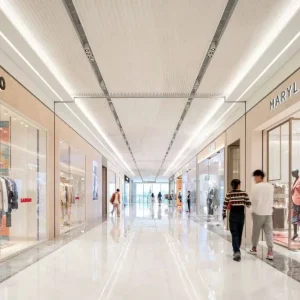
Coverage ranges from a single officer stationed at a lobby or gate to patrols that walk the grounds on a set schedule,
checking doors, fence lines, and parking areas between rounds. Every posting is unarmed and scoped around what
the property actually needs, not a fixed package.
Guards work best paired with the cameras already covering a site, since an officer on patrol can only be in one place
at a time while live monitoring watches every angle at once — together they cover the ground and the gaps between
rounds.
Businesses typically bring guards on for scheduled hours around a specific risk window, a temporary posting during
construction or an event, or a standing contract covering entry points every day. Pricing depends on hours and site scope
and site scope — contact us for a quote built around your property
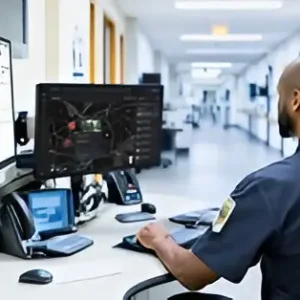
Security cameras and remote monitoring help identify and assess suspicious activity, while on-site guards provide a physical presence for tasks such as verifying identification, managing access, and responding to situations that require someone at the property.
An on-site guard can manage visitor access, check doors and gates, conduct scheduled patrols, and assess situations that require a physical presence. These responsibilities complement video monitoring by providing assistance in areas where cameras alone cannot take action.
A guard closes that distance — present at the point where a decision has to be made in person, not reviewed after the fact from a recording.
<span>
What a Guard Adds That a Camera Can’t
</span>
The unit mounts to whatever structure already has a clear sightline — a pole, an eave, or an exterior wall — using the property’s existing power where it’s available, so a crew is on and off site in a single visit.
Once mounted, it connects over a cellular link or the site’s own network connection, sending live video straight to a monitoring center rather than storing it locally for someone to review later after the fact.
Active job sites lose equipment and materials to unsupervised overnight hours — the exact gap live monitoring is built to close.
Temporary or relocatable camera coverage may be available for suitable retail properties, depending on site requirements, equipment availability, and the selected monitoring plan.
Office buildings, financial institutions, and other commercial properties need monitored coverage of entry points and parking areas outside business hours, when the building sits empty.
Virtual Guard CCTV is a modern security company built to help businesses protect their properties with smarter technology, live monitoring, and real human intervention.
We believe security should be proactive, not reactive. Instead of only recording incidents after they happen, our system combines AI-powered detection with trained live operators who monitor activity, verify threats, issue warnings, and respond in real time.
Our team supports construction sites, commercial properties, apartment communities, warehouses, retail locations, parking facilities, and high-risk environments that need dependable protection.
Guard coverage isn’t sold as one fixed package — a lobby desk, a construction site, and a multi-building
campus each need a different staffing shape.
Some properties need one officer stationed at a single entrance during business hours. Others need patrol coverage that rotates across a larger footprint on a set schedule through the night.
Short-term postings cover a construction phase, a special event, or a seasonal spike, while standing contracts provide ongoing security coverage for locations that require regularly staffed posts.
Uniformed officers, shift documentation, and direct coordination with our monitoring center — not just a
body posted at a door for the length of a shift.
Every officer is unarmed, uniformed, and equipped with a radio for direct contact with our monitoring center if a situation needs a second set of eyes on camera. Shift activity is documented so property owners have a record of what was checked and when.
Guard postings can run alongside existing camera coverage, giving a property both a live view of the whole site and a physical presence at the points that need one most.
Tell us the posts you need covered and the hours they matter, and we’ll come back with an officer schedule and a per-post cost.
On-site officers are scheduled around each property's hours and risk, from single-post coverage to multi-site contracts.
What owners want to know before they put an officer on a property.
On-site security guards provide a physical presence on your property — patrolling grounds, monitoring entry points, checking credentials, and responding directly to activity as it happens. Depending on the posting, duties can include walking scheduled patrol routes, staffing a lobby or gate, checking that doors and access points stay secured, and documenting anything unusual for the property owner. Unlike a camera feed, a guard on-site can approach a person directly, ask questions, and step in rather than only observing and reporting. Coverage is scoped to what each property needs, from a single fixed post to patrols across a larger site.
Guard staffing cost depends on how many officers are posted, the hours covered, and what the posting requires — a single lobby post is priced differently than multiple officers patrolling a large site around the clock. Because those variables shift so much from one property to the next, we don’t publish a flat rate; every guard services engagement is quoted after we understand your site’s size, risk profile, and coverage hours. Contact us for a quote scoped to your property.
The two aren’t an either/or choice — many properties run both. Remote video monitoring covers broad areas continuously through cameras and a monitoring center operator, which works well for perimeters, parking lots, and after-hours coverage where a live view is enough to verify and respond. On-site guards make sense when a property needs someone physically present — checking IDs at an entry point, walking a large footprint on foot, or managing people on the property in real time. Many businesses layer guard coverage for specific hours or areas on top of camera monitoring that runs continuously across the rest of the site.
Staffing depends on your property’s size, layout, number of entry points, and the hours you need covered — a single-entrance office needs a different posting than a multi-building site with several access points. Rather than apply a generic formula, we assess your property’s footprint and risk profile and recommend a staffing plan sized to what you actually need, whether that’s one officer or a coordinated patrol schedule. Contact us for an assessment specific to your property.
Virtual Guard CCTV provides unarmed security guard services only. Officers are trained to observe, patrol, verify credentials, document incidents, and contact law enforcement when a situation requires it — the goal is a visible, professional presence and an accurate response, not armed confrontation. For properties that also want continuous camera coverage, unarmed guard postings can run alongside live video monitoring for the hours or areas a guard isn’t physically covering.
A visible, uniformed guard on patrol is a deterrent in itself — most people looking to break in or steal from a property
look for the path with the least chance of being seen, and a guard walking scheduled rounds or staffing an entry point
removes that assumption.Guards can also intervene when they observe suspicious activity, rather than only recording it. Depending on the situation and their assigned responsibilities, they may secure an entry point, maintain their position, or contact law enforcement. We don’t publish a specific prevention percentage, since no independent, sourced study establishes one
service.